The Stories Behind the World's Most Famous Clocks


There is a certain kind of human ambition that refuses to be quietly useful. It insists on being beautiful, permanent, and seen.
Nowhere is this more visible than in the great clocks of the world — those immense, intricate timekeepers that cities have placed at their hearts for centuries, not merely to announce the hour, but to announce themselves.
A clock tower is a city's handshake with time. It says: we were here, we measured this, we mattered. From the fog-draped Thames to the sun-bleached squares of medieval Prague, these machines of brass and stone have witnessed coronations, revolutions, wars, and the quiet, ordinary passage of a million ordinary days.
From the corridors of ancient empires to the spires of modern cities, discover the famous clocks of the world — six extraordinary timepieces whose stories make them far more than mere timekeepers.
1. Big Ben, London — The Voice of an Empire
Ask anyone on earth to picture a clock, and there is a good chance they picture this one. The great bell tower rising above the Palace of Westminster has become so synonymous with London — with Britain itself — that it seems less like a building and more like a force of nature.
Completed in 1859, the tower officially bears the name Elizabeth Tower, a title bestowed in 2012 to mark the Diamond Jubilee of Queen Elizabeth II.
But nobody calls it that. The name everyone uses — Big Ben — technically belongs to the bell inside, the Great Bell, cast in Whitechapel and weighing a colossal 13.7 tonnes.

How the bell's nickname came to swallow the entire structure whole is a small mystery of popular language that even historians debate.
The clock itself is an engineering marvel of the Victorian age. Its four dials, each seven metres in diameter, are made not of glass but of opal glass panes set in an iron frame.
The hands are made of hollow copper to reduce weight without sacrificing scale. And the famous chimes — those four descending notes that have marked the hour on radio broadcasts since 1923 — are tuned to the key of E major, drawn from a phrase in Handel's Messiah.
During the Second World War, the BBC suspended the visual broadcast of the clock face to prevent German bombers from using it for navigation. The chimes, however, continued to ring — a deliberate act of defiance, a reminder to occupied Europe that London still stood and still kept time.
The pendulum inside Big Ben weighs 300 kg and is 3.9 metres long. Its rate is adjusted by adding or removing old pennies to a small tray attached to the pendulum shaft — each penny changes the clock's speed by approximately 0.4 seconds per day. Precision at this scale is achieved not by complexity, but by patience.
2. The Prague Astronomical Clock — A Medieval Cosmology in Motion
In the Old Town Square of Prague, every hour on the hour, a small drama unfolds. Wooden figures stir. The skeleton of Death rings a bell. The Twelve Apostles parade past two small windows.
A cock crows. And the crowds gathered below — thousands of them, every single day — exhale in collective wonder at something that has been doing exactly this since the fifteenth century.
The Prague Astronomical Clock, known in Czech as the Orloj, was first installed in 1410, making it one of the oldest working astronomical clocks in the world. What makes it extraordinary is not just its age, but its ambition.
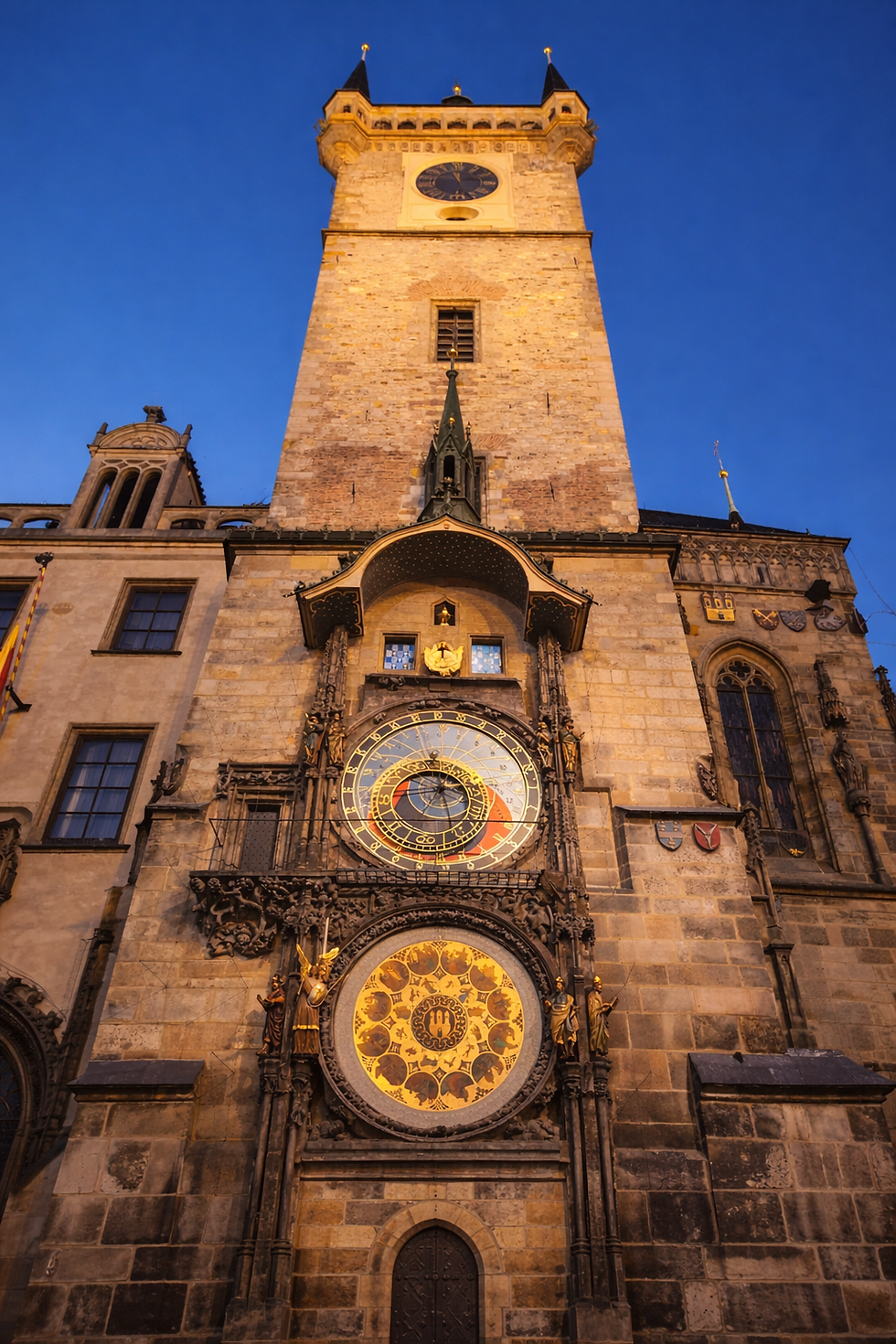
This is not a clock that merely tells the time. It displays the position of the sun and moon against the backdrop of the zodiac. It shows the time in three separate systems — Old Czech time, Central European time, and Babylonian time.
It has a calendar dial beneath the main face that tracks the day of the year and the feast days of the Catholic church.
The medieval mind did not separate science from theology. To know the movement of celestial bodies was to participate in the divine order of creation.
The Orloj is a machine built by people who believed that understanding the heavens was an act of piety. That philosophy is visible in every gear.
Legend holds that the city authorities, fearing that its creator — the clockmaker Hanus — might build something equally magnificent for a rival city, had him blinded upon completion.
Whether true or not, the story has clung to the clock for six centuries, adding a dark mythology that only deepens its allure.
The Orloj uses an astrolabe — an ancient astronomical instrument — as its primary display. The golden sun pointer moves along the zodiac ring completing one full circuit in approximately 365.25 days, tracking the solar year with remarkable accuracy using only mechanical gearing.
3. The Rathaus-Glockenspiel, Munich — A Clock That Tells Stories
Most clocks tell you what time it is. The Glockenspiel in Munich's Marienplatz tells you who you are — or at least, who the Bavarians were, and are proud to remain.
Built in 1908 as part of the new Neues Rathaus (New Town Hall), the Glockenspiel is less a clock than a theatre. Three times a day, its 43 bells begin to ring and 32 life-sized figures spring to life across two tiers of performance.

The upper tier re-enacts the 1568 wedding of Duke Wilhelm V, complete with a jousting tournament in which the Bavarian knight triumphantly defeats his opponent. The lower tier performs the Schäfflertanz — the coopers' dance — said to have been first danced in 1517 to lift the spirits of citizens terrorised by plague.
There is something gloriously unashamed about the Glockenspiel. It does not merely mark time; it celebrates a particular people's sense of themselves.
Every chime is an act of civic pride. And for the hundreds of visitors who gather in Marienplatz each day, watching the figures spin and joust in their gilded alcoves, it works. Time stops feeling like an abstraction and starts feeling like a story.
The 43 bells of the Glockenspiel are arranged in two sets: the carillon bells, which play the melody, and the larger bourdon bells that provide the bass. The mechanism governing the choreography of the 32 figures — ensuring each character moves in correct sequence without tangling — is an extraordinary feat of mechanical cam engineering.
4. The Strasbourg Cathedral Clock — Six Centuries of Reinvention
Some clocks are built once and admired. The great astronomical clock of Strasbourg Cathedral has been built, destroyed, rebuilt, and reimagined across six hundred years — a machine that is less a single object than an ongoing argument between humanity and time about who is really in charge.
The first clock was installed in the cathedral in 1352. It ran for almost two centuries before breaking down irreparably. A second, more elaborate clock was built in the 1570s and ran until the early 1700s, when it too fell silent.

The third — and current — clock was completed in 1843 by the mathematician and engineer Jean-Baptiste Schwilgué, who had spent decades studying the original mechanism as a child and vowed to restore it.
What Schwilgué built was not a restoration but a masterpiece in its own right. The clock stands eighteen metres tall and displays an astonishing array of information: the time, the day, the date, the month, the year, the position of the sun and moon, the occurrence of eclipses, and a perpetual calendar accurate until the year 9999.
At noon each day, gilded figures of the Twelve Apostles file past a figure of Christ, who blesses each one as they pass. A mechanical cock crows three times. Death strikes the bell.
The Strasbourg clock is a reminder that the greatest achievements in horology are rarely the work of a single moment of genius. They are the product of accumulated obsession, passed from one generation of makers to the next.
Schwilgué's clock incorporates a perpetual calendar mechanism — a gear train that correctly accounts for leap years, including the rule that century years are not leap years unless divisible by 400. Encoding this exception mechanically required a gear with 400 teeth, driven at precisely the right ratio. It took Schwilgué years to calculate and execute.
5. The Shepherd Gate Clock, Greenwich — The Clock That Rules All Clocks
It is a modest-looking thing, as far as world-changing objects go. A black iron gate at the Royal Observatory in Greenwich, London. Above it, a clock face of no particular grandeur. And yet this clock, installed in 1852, is in a very real sense the clock against which every other clock on earth is measured.
Greenwich Mean Time — GMT — was established as the global standard for timekeeping as the British railway network expanded in the mid-nineteenth century.
Before standardisation, every town kept its own local time, calibrated by the sun's position overhead. Bristol, for instance, ran ten minutes behind London.
This was charming until trains started running at speed, and 'ten past three' meant something different depending on which platform you were standing on.

The Shepherd Gate Clock was one of the first public clocks in the world to display GMT continuously — piped from the Observatory's master clock via electrical telegraph.
It is also notable for being a 24-hour clock, its single hand completing one full revolution per day rather than two. For a Victorian public accustomed to the familiar twelve-hour face, this was startlingly radical.
Today, the Observatory is the meridian point from which all longitude on earth is measured. Stand astride the brass line in the courtyard and you have one foot in the eastern hemisphere, one in the western.
The Shepherd Gate Clock hangs above that line — a quiet, unassuming reminder that someone, at some point, had to decide where time begins.
The original Shepherd clock used a sympathetic resonance mechanism: a slave clock driven by electrical impulses from a master pendulum clock inside the Observatory. Every hour, an electrical signal reset the slave mechanism. This master-slave system was the forerunner of all synchronised timekeeping networks, including the GPS satellite systems that calibrate our phones today.
6. The Clock of the Long Now — A Clock for Civilisation
All the clocks we have discussed so far were built to serve a city, a cathedral, a nation. The Clock of the Long Now — also called the 10,000-Year Clock — was built to serve something larger: the very idea of civilisation itself.
Conceived by inventor Danny Hillis in 1986 and championed by the Long Now Foundation, this clock is being constructed inside a mountain in the high desert of West Texas, funded in part by Amazon founder Jeff Bezos.
It is designed to tick once per year, its century hand moving once every hundred years, its cuckoo appearing once per millennium — and to keep accurate time for ten thousand years without human intervention.

The project is, in one sense, an engineering challenge of extraordinary difficulty: building a mechanism that will survive ice ages, shifts in the earth's magnetic field, civilisational collapse, and the simple accumulation of dust.
But it is also, more profoundly, a philosophical statement. We live in an age of radical short-termism, where quarterly earnings and next week's news cycle dominate human attention.
The Long Now Clock is an argument that we are capable of thinking — and building — for the long term.
It is a clock that nobody alive today will see complete its first millennium. That is the point. It exists not to be used, but to be humbling.
The Long Now Clock uses a precision mechanical binary digital display and a solar synchroniser — each solar noon, a shaft of sunlight enters the mountain and corrects any accumulated drift, keeping the clock calibrated to the sun itself rather than to any human-maintained standard. It is the most ancient form of timekeeping, fused with the most ambitious.
What the Famous Clocks of the World Have in Common — And Why It Matters
Look back at the six clocks above and a pattern emerges. Not one of them was built simply to tell the time. Big Ben was built to project imperial confidence. The Orloj was built to map the cosmos.
The Glockenspiel was built to narrate civic identity. Strasbourg was rebuilt as an act of personal obsession. Greenwich was built to impose order on a chaotic modern world. The Long Now was built to slow us down.
Every great clock is an argument — about what time means, what we owe to it, what it owes to us. The clockmakers who built these extraordinary machines were not just engineers. They were philosophers working in brass and iron, asking the oldest question there is: what does it mean to mark a moment?
We believe that spirit lives in every clock we make — from the grandest tower to the quietest mantel piece. A clock is never just a clock. It is a small, beautiful claim that this moment is worth marking.


Comments